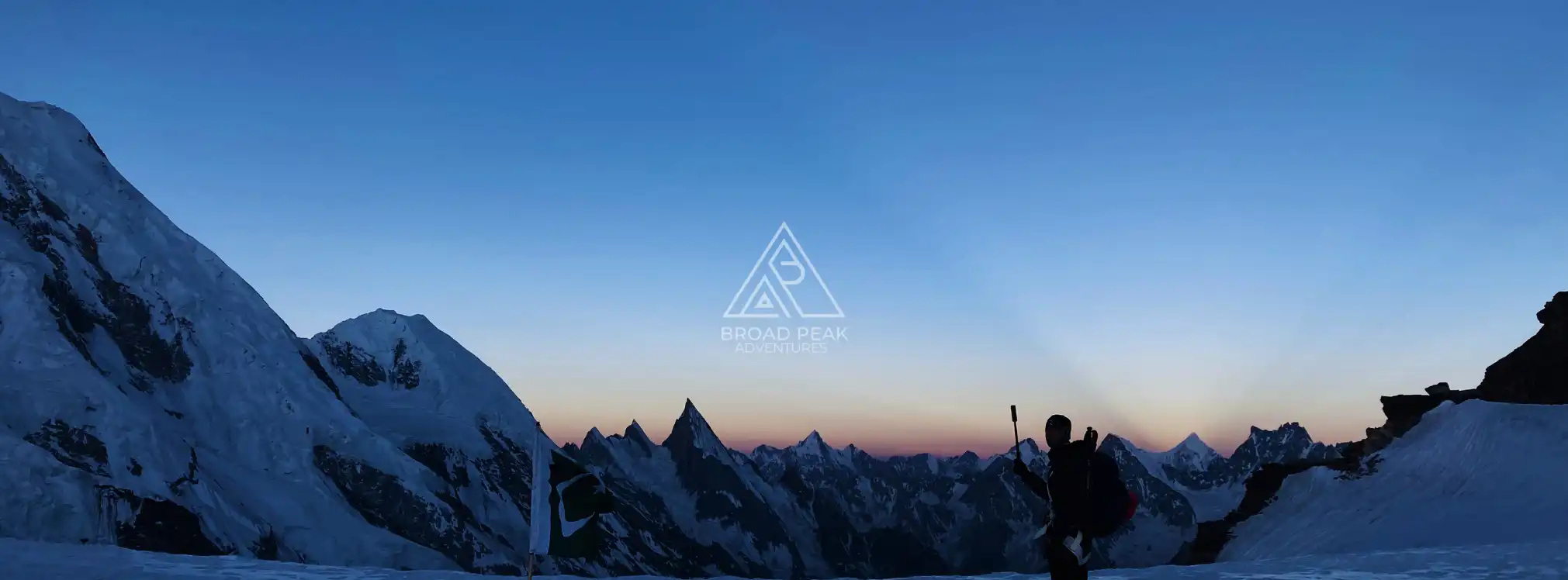
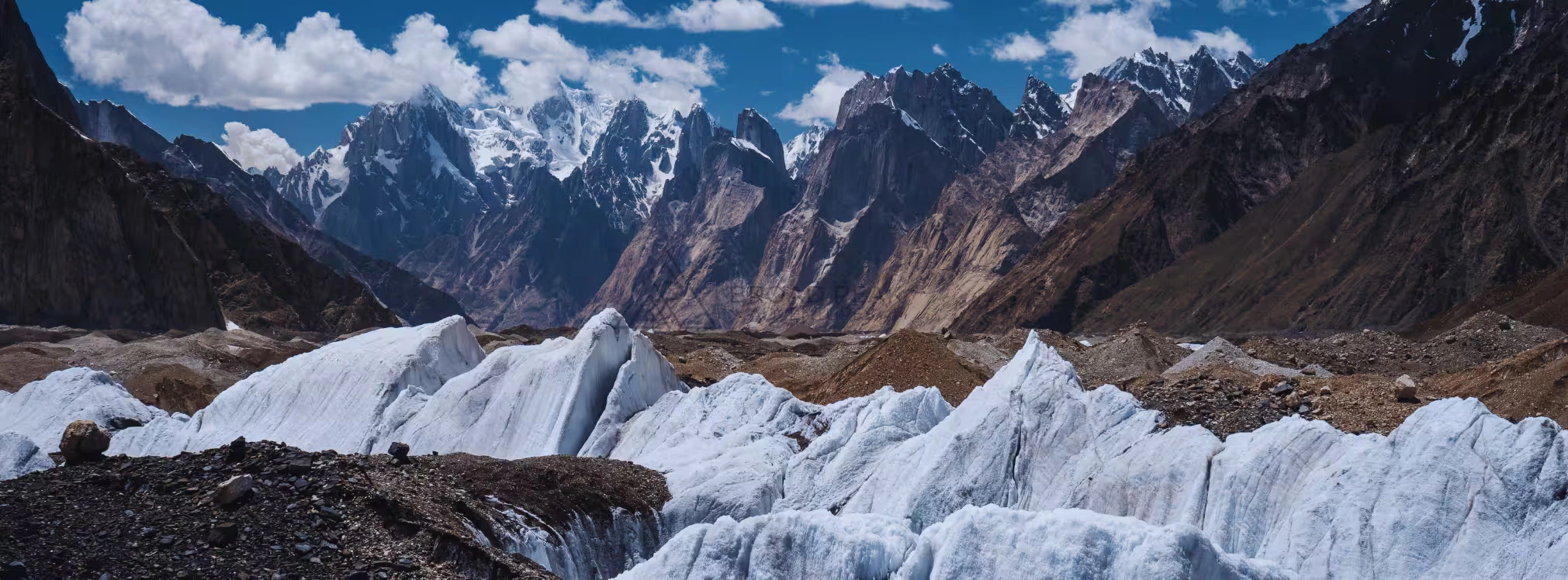
The ice caves of Arandu Valley stand out as one of the most remarkable natural sights emerging in Pakistan's Karakoram Range — a glowing, cathedral-like world of deep blue ice and sculpted tunnels, hidden inside the ancient Chogo Lungma Glacier, just four hours from Skardu.
Where They Are Located
Arandu Valley sits in the upper part of Shigar District, approximately four hours by jeep from Skardu city. The valley acts as a natural gateway to several famous peaks and glaciers in the Karakoram, including Spantik (7,027m) and Malubiting (7,458m). The Chogo Lungma Glacier — one of Pakistan's great ice rivers, stretching 44km into the mountains and first discovered by European science in 1835 — flows down from high mountain cols toward the village, and the ice caves appear near the glacier's lower end, where meltwater has carved dramatic passages through the ice over thousands of years.
The landscape around the caves features rugged granite summits, snow-covered slopes, and the stark, dramatic beauty typical of high-altitude Baltistan. The journey to reach them becomes part of the adventure itself — driving through the Shigar Valley past traditional villages, apricot orchards and canyon walls before the road narrows into the raw Basha Valley above.
How the Caves Were Created
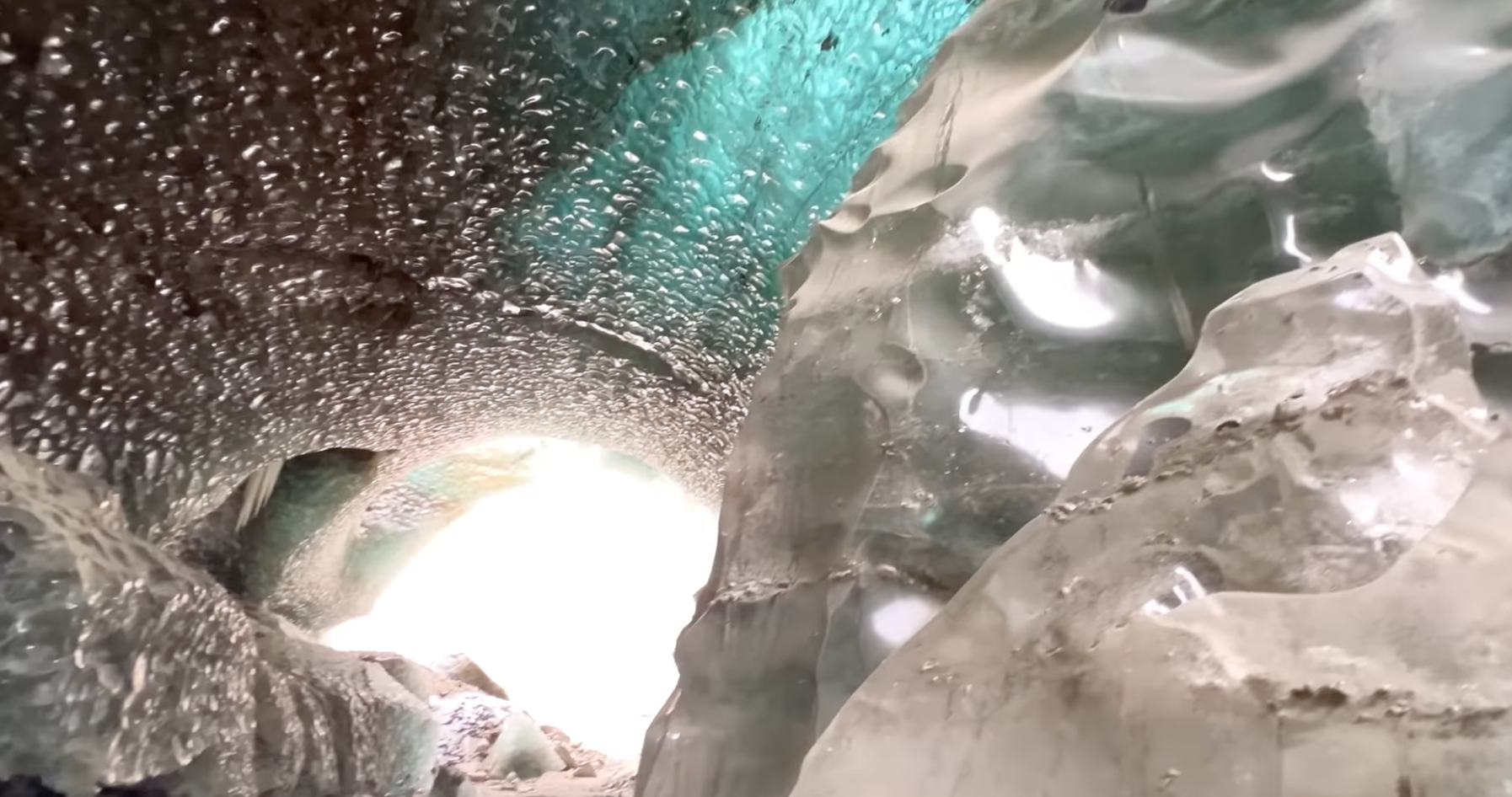
These caves formed through natural glacial processes accelerated by changing climate patterns. In warmer months, meltwater from the glacier surface and deeper layers flows through the ice and slowly widens tunnels and hollows. Over the years this creates complex networks of passages, scalloped ceilings, frozen waterfalls, and translucent walls that catch the light in stunning ways.
Recent years have shown clear retreat of the Chogo Lungma Glacier, with noticeable shortening of its length. This retreat has uncovered and enlarged the cave systems, revealing structures that were once hidden or harder to reach. The caves are a powerful example of how glaciers respond to environmental change — combining breathtaking beauty with a quiet reminder of how fragile these frozen landscapes really are.
The snout of the Chogo Lungma Glacier was called "the grandest spectacle" by explorer Godfrey Vigne on his 1835 travels — and the ice caves forming there today are among the most extraordinary natural wonders in Pakistan.
What It Feels Like Inside
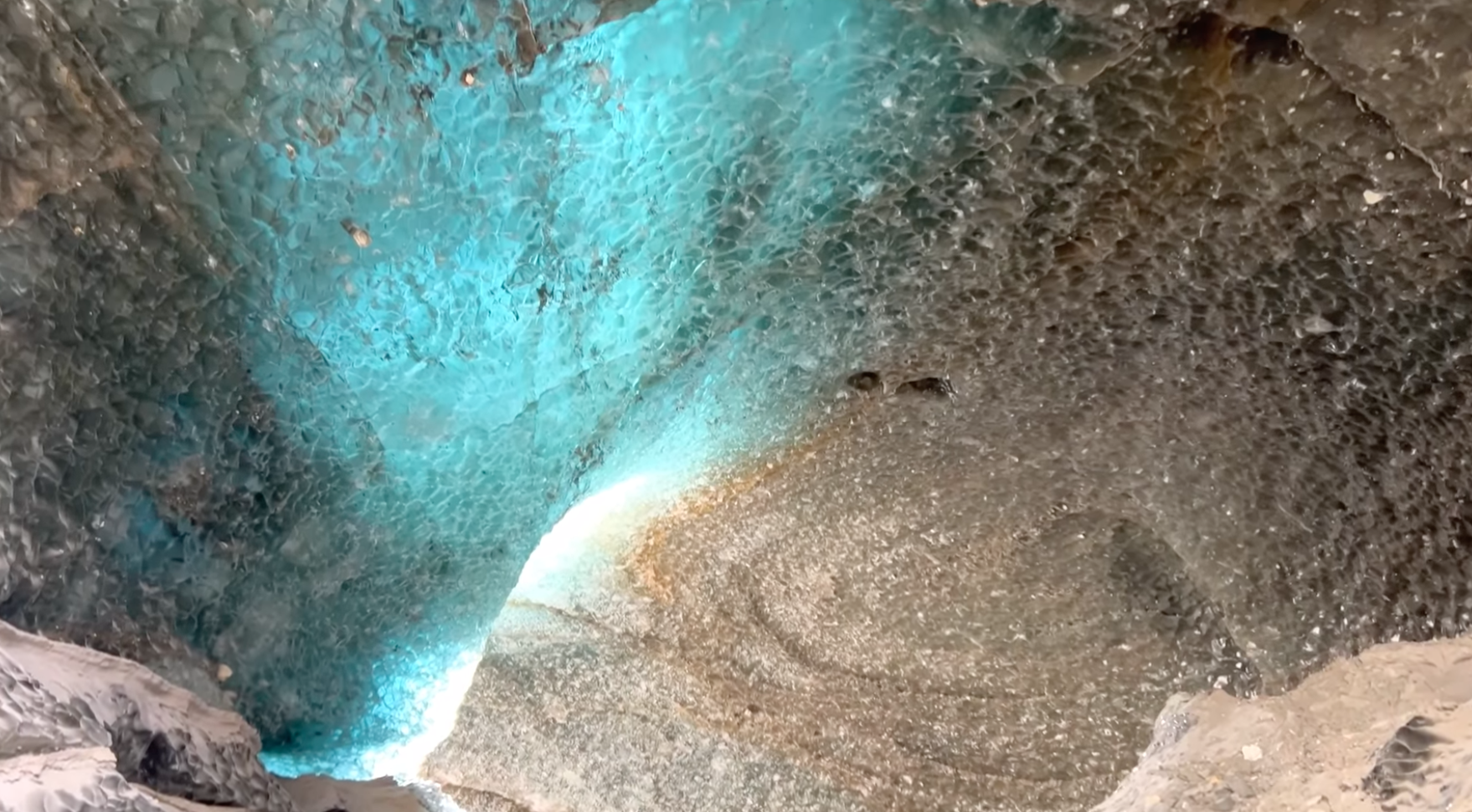
Walking into these caves feels like entering an icy cathedral. Sunlight passes through thick layers of blue ice and creates a soft, glowing light that fills the space. You can see swirling patterns and crystal-clear formations along the walls. The air stays quiet except for the occasional soft drip of water, though everything freezes solid in winter. The walls often show intricate textures shaped by sublimation and uneven melting.
Many of the passages allow for safe exploration. You can get close to the natural ice sculptures and admire them up close. In winter the entire structure becomes rock-solid, which makes the deep turquoise and sapphire colours even more intense — a phenomenon caused by the way glacial ice absorbs red light wavelengths and transmits blue.
- Glacial ice is extremely dense — air bubbles are compressed out over centuries of pressure
- Dense ice absorbs red and yellow wavelengths of light more strongly than blue
- The deeper you go into a glacier, the more blue and turquoise the light becomes
- Arandu's caves glow most intensely in midwinter when ice is at maximum density and stability
Best Time to Visit
Winter, from December to February, is the only season experts recommend for safe visits. During these months meltwater stops flowing, and the caves freeze into stable, solid formations. The deep turquoise and sapphire colours are at their most intense, and the cave walls are at their most dramatic and sculptural.
Summer visits carry serious risk. Flowing meltwater weakens the ice structure and significantly raises the chance of sudden collapse. Do not attempt to enter glacier caves at Arandu between May and October without checking conditions with an experienced local guide first.
How to Get There
The route to the caves is straightforward with the right logistics in place. Here is the step-by-step journey from Skardu:
Safety Guidelines
Glacier caves deserve careful respect. The following guidelines are non-negotiable for a safe visit:
- Always go with a certified local guide who knows the site and current conditions.
- Wear crampons, helmet, and proper clothing, the temperature inside the caves is well below freezing.
- Avoid loud noises or sudden movements that might disturb ice formations
- Check current conditions the glacier is dynamic and cave structure changes seasonally
- Winter only December to February are the only months recommended for cave entry
- Tell someone your plans and expected return time before entering the glacier area
READY TO EXPLORE THE ICE CAVES?
Broad Peak Adventures arranges private 4-day Arandu Valley experiences — 4x4 transport from Skardu, local guide, Balti homestay accommodation and guided cave access. No permits required.
Why This Place Matters
The ice caves of Arandu Valley bring together adventure, natural beauty, and a direct connection to one of the planet's most important freshwater reserves. The Chogo Lungma Glacier feeds the Basha River, which feeds the Shigar River, which feeds the Indus — one of Asia's great rivers. What happens to this glacier matters far beyond the valley.
For people already trekking in the Karakoram or those looking for a focused winter experience, the caves make a perfect and unforgettable addition to any trip in northern Pakistan. They also offer something increasingly rare in adventure travel: a genuinely undiscovered destination where you are unlikely to encounter another visitor, where the local community still benefits directly from every booking, and where the landscape itself has not yet been shaped by mass tourism.
Arandu Valley falls in Pakistan's open zone — no advance trekking permits are required, which makes logistics simpler than most Karakoram destinations. The local Arandu community are the guardians of the glacier and the best possible guides through it. Supporting community-led expeditions here is one of the most direct ways a traveller can contribute to the long-term preservation of the region.